
If you've ever shopped for sheets, you've been sold thread count. The higher the number, the story goes, the better the fabric. That logic has bled into menswear — dress shirts, in particular, get marketed with thread counts of 80, 100, 120, even 200. It sounds precise. It sounds like quality. It is, for the most part, noise.
The spec that actually tells you something useful about how a fabric will feel, drape, breathe, and wear over time is far simpler: weight. Measured in grams per square metre (GSM) or ounces per square yard, fabric weight is the single most predictive number in all of clothing. And almost nobody talks about it.
The Problem With Thread Count
Thread count measures how many yarns — warp and weft combined — are woven into one square inch of fabric. A 120-thread-count shirting has 120 threads per square inch. That sounds like a lot, until you realize two things.
First, thread count tells you nothing about the quality of the yarn itself. A high thread count made from short, weak cotton fibres produces a fabric that's dense but fragile — it pills, it shines after ironing, and it tears along creases. A lower thread count made from long-staple cotton will outlast it by years.
The number on the label tells you how many threads are in the cloth. It says nothing about how good those threads are.
Second, thread count is gameable. Manufacturers twist multiple thin yarns together and count each ply separately, inflating the number without improving the fabric. A "1000-thread-count" sheet is often a 250-thread-count fabric that's been double- and triple-plied. The consumer sees a big number. The fabric is mediocre.
In shirting, thread count does give a rough sense of fineness — a 120s poplin is smoother and more delicate than an 80s Oxford. But even here, the yarn quality (long-staple vs short-staple cotton) and the weave matter more than the count. Thread count is a hint. Weight is a measurement.
What GSM Actually Tells You
GSM — grams per square metre — measures how much material is in a given area of fabric. It's a direct indicator of density. A lightweight summer shirt might be 120 GSM. A heavyweight t-shirt might be 240 GSM. A tweed overcoat can exceed 500 GSM. The number maps cleanly onto how the fabric behaves.
| Weight (GSM) | Typical Garment | Character |
|---|---|---|
| 80–120 | Summer linen shirts, voile | Airy, sheer, wrinkles freely |
| 120–160 | Year-round dress shirts, poplin | Balanced, versatile, drapes cleanly |
| 160–220 | Oxford cloth, casual shirting | Substantial, textured, holds shape |
| 200–280 | Lightweight suiting, fine wool | Smooth drape, travel-friendly |
| 280–340 | Heavyweight tees, mid-weight wool | Structured, opaque, insulating |
| 400+ | Outerwear, tweed, overcoating | Rigid, warm, built for decades |
Notice what the table captures that thread count cannot: behaviour. A 140 GSM poplin and a 200 GSM Oxford can have the same thread count and the same fibre content, but they'll feel completely different on the body. The heavier fabric is more substantial, more opaque, and more forgiving. The lighter fabric breathes better but shows every line underneath.
How Weight Affects Fit and Drape
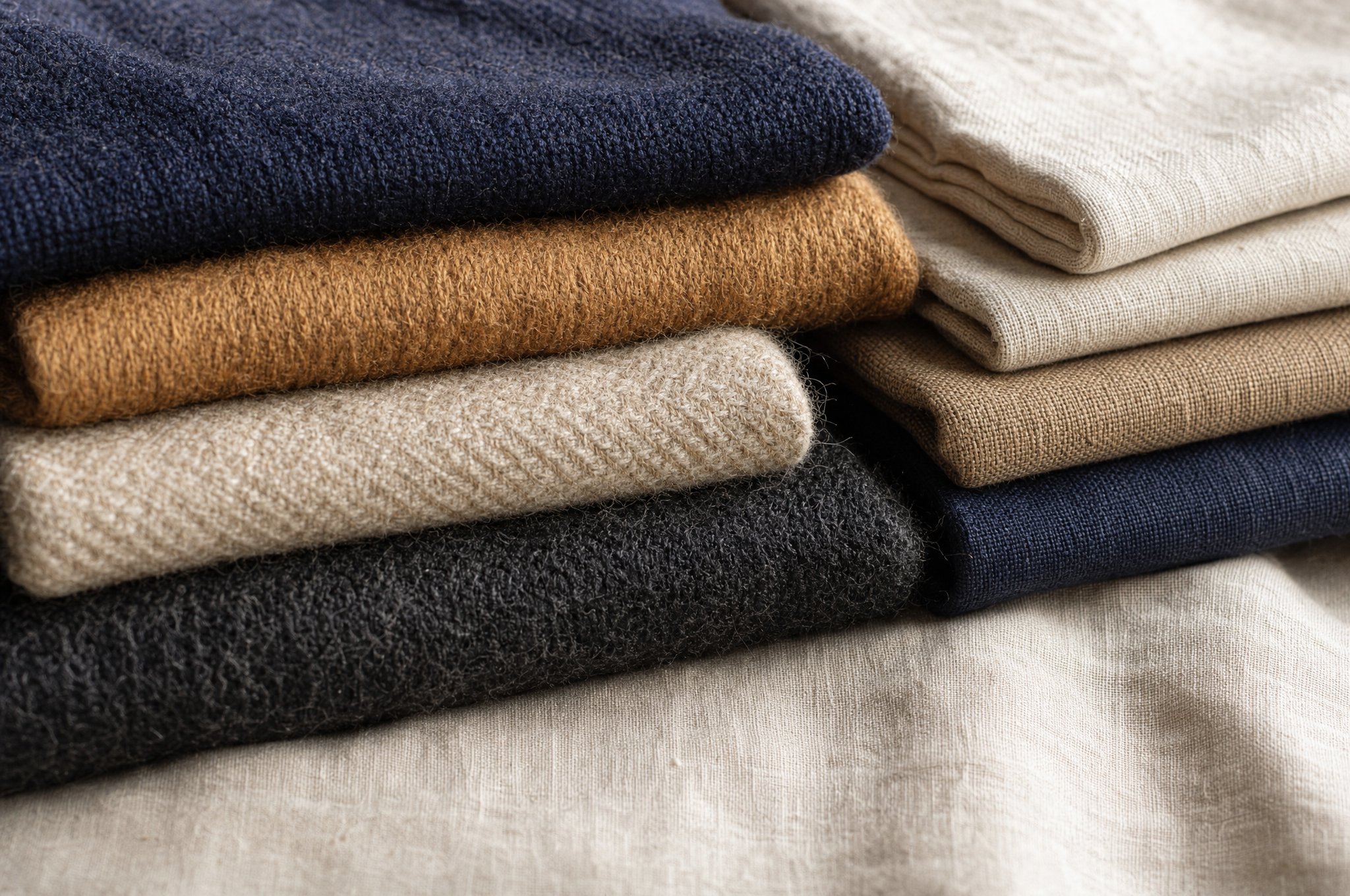
Drape — how fabric falls and moves — is governed by weight more than any other factor. Lighter fabrics drape fluidly; they follow the body and create soft folds. Heavier fabrics drape in larger, more sculptural folds; they hold their own shape against the body.
This is why a lightweight wool suit (around 240 GSM) looks elegant and soft, while a heavy tweed jacket (450+ GSM) looks structured and architectural. Neither is better — they're designed for different purposes. But if you've ever wondered why your summer trousers look "floppy" compared to your winter ones, weight is the answer.
If a garment looks limp, sheer, or clings to every contour, the fabric is probably too light for its purpose. If it feels stiff, unyielding, or traps heat, it's probably too heavy. The right weight matches the garment's job.
Weight and Seasonality
Fabric weight is the foundation of seasonal dressing. The principle is simple: lighter fabrics breathe and release heat; heavier fabrics insulate and retain it. But the relationship isn't linear — weave structure matters too. An open plain weave at 200 GSM will breathe better than a tight twill at the same weight.
For year-round versatility in a temperate climate, aim for the middle ranges: shirting around 140–180 GSM, suiting around 250–300 GSM, and knitwear around 300–350 GSM. These weights perform adequately across most seasons without excelling in any single one. They're the workhorses of a wardrobe.
For dedicated summer pieces, drop below 140 GSM in shirting and below 250 GSM in suiting. Linen, cotton voile, and lightweight wool excel here. For winter, climb above 200 GSM in shirting (flannel, brushed Oxford), above 320 GSM in suiting (flannel, tweed), and above 350 GSM in knitwear. Layering lets you extend the range of mid-weight pieces further than the weight alone would suggest.
Why Brands Don't Adise GSM
Most clothing brands don't list GSM on their product pages. There are two reasons. First, most consumers don't know what it means, so there's no demand. Second — and more cynically — if brands listed GSM, it would be immediately obvious which products are using thin, cheap fabric and which are using substantial, quality cloth.
A fast-fashion t-shirt at 140 GSM and a quality heavyweight tee at 220 GSM would reveal their difference instantly. A summer suit at 200 GSM and a proper year-round suit at 280 GSM would no longer be sold at the same price with the same "premium wool" copy. GSM is transparency, and transparency is not always in the seller's interest.
Brands that do list fabric weight tend to be the ones proud of it. When you see a t-shirt described as "240 GSM heavyweight" or a shirt as "7.5 oz Oxford," you're usually looking at a manufacturer that chose the fabric deliberately. The number is a signal of intent.
How to Estimate Weight Without a Spec
If GSM isn't listed, you can estimate it with your hands. Hold the fabric up to a light source. How much light passes through? A fabric you can nearly see through is probably under 130 GSM. A fabric that's fully opaque even under bright light is likely above 200 GSM.
Then drape it over your hand. Does it collapse under its own weight, or does it hold some structure? Lighter fabrics collapse; heavier fabrics hold. This is the same drape test a tailor uses when choosing cloth, and it works just as well in a fitting room.
Finally, compare. If you own a garment whose weight you know — a well-documented heavyweight tee, for instance — hold the new fabric next to it. The difference is usually immediately apparent. Your hands are more sensitive to fabric weight than any spec sheet.
The Bottom Line
Thread count is a marketing number that describes the arrangement of yarns. Fabric weight is a physical measurement that describes how the material actually behaves. One is story; the other is substance.
When you're evaluating a garment — whether it's a dress shirt, a t-shirt, a suit, or a pair of trousers — ask about weight first. If the brand doesn't list it, estimate it with the light test and the drape test. If you're buying online and can't touch the fabric, look for brands that do publish GSM and prefer them. The number tells you more about how the garment will wear over the next five years than any other spec on the page.
Fabric weight isn't a secret. It's just ignored. Start paying attention to it, and you'll make better clothing decisions almost immediately — no thread count required.