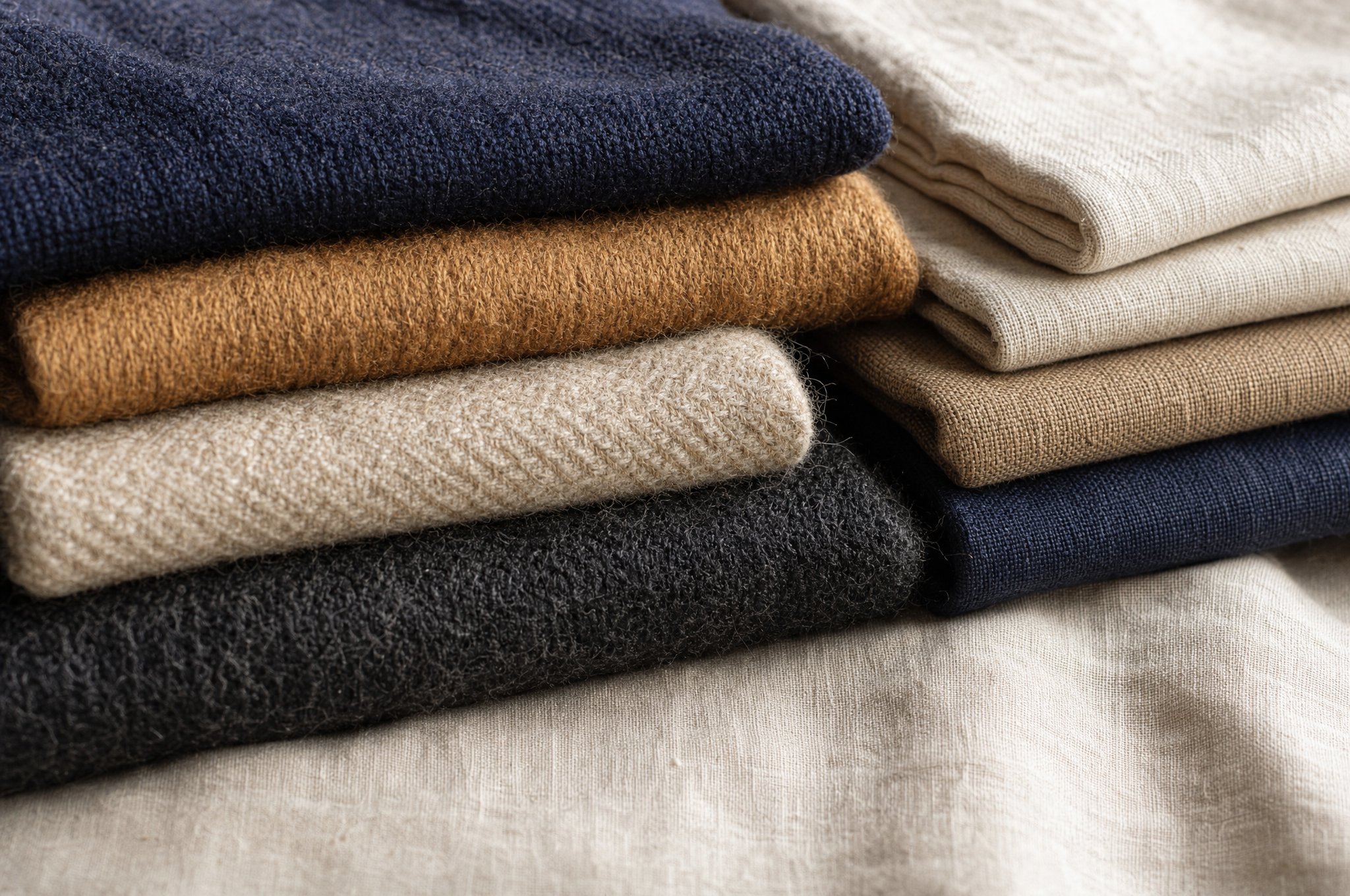
Before you can judge a garment, you need to understand the material it's cut from. This hub collects our fabric knowledge in one place — fibres, weaves, weights, and how each behaves on the body and over time.
Use it as a dictionary when a label confuses you, or read through category by category. Every entry links to a deeper article where one exists.
The materials that make up the overwhelming majority of a man's wardrobe, broken down by fibre, weave, and behaviour.
The most versatile natural fibre in menswear — from superfine Merino base layers to rugged tweed overcoats. Weight, micron count, and weave determine everything.
Read the wool guide →Oxford, poplin, twill, flannel, and jersey. Cotton's weave matters more than its origin — the same fibre behaves wildly differently depending on how it's constructed.
Read about cotton weight →The warm-weather fibre. Linen wrinkles — that's the point. Learn why its open weave breathes so well and when the rumple is a feature, not a flaw.
See seasonal guides →Wool and cashmere knits — sweaters, cardigans, and the care they demand. Pilling, stretching, and moths are all survivable with the right habits.
Read knitwear care →A cotton twill with a cult following. Raw, sanforized, selvedge — the vocabulary is dense but the logic is simple once you understand the weave.
Read the denim guide →Full-grain, top-grain, genuine, bonded — the grades that determine whether a leather good lasts decades or disintegrates in a season.
Read the leather guide →If you take one concept from this hub, make it fabric weight. It does more to predict a garment's behaviour than any other single spec.
| Weight (GSM) | Typical Use | How It Wears |
|---|---|---|
| 80–120 | Summer shirts, linings | Airy, translucent, creases easily |
| 120–160 | Year-round dress shirts | Balanced drape, versatile |
| 160–220 | Oxford cloth, casual shirting | Substantial, holds shape |
| 200–280 | Lightweight suiting, fine wool | Drapes well, travel-friendly |
| 280–400 | Heavyweight tees, mid-weight wool | Structured, insulating |
| 400+ | Outerwear, tweed, overcoating | Rigid, warm, built for decades |
Material knowledge only matters when it informs what you buy and how you wear it. The journal applies these concepts to real wardrobe decisions.
Browse the Journal