
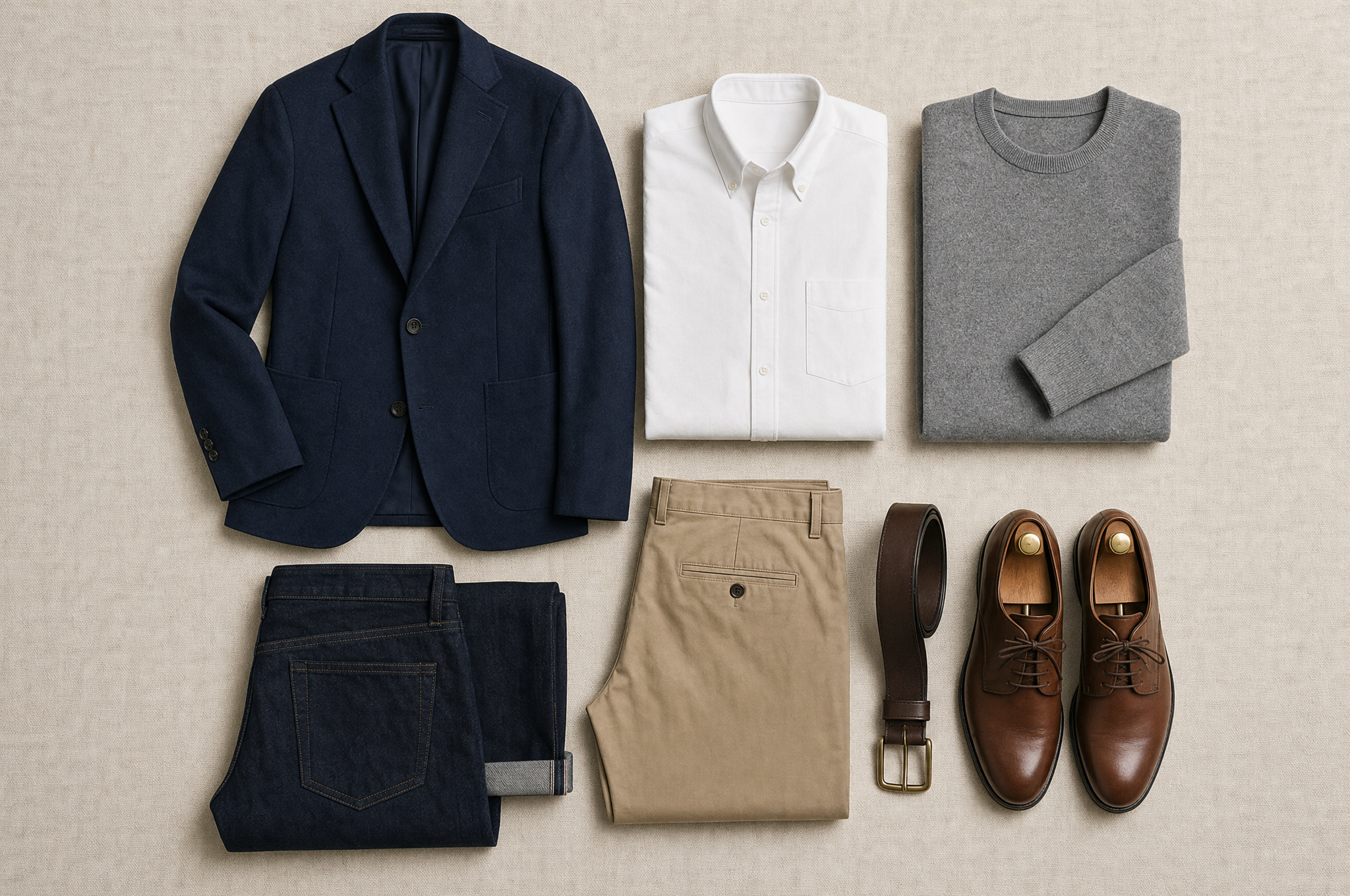
The hardest weather to dress for isn't winter or summer. It's the in-between — those weeks in spring and autumn when the morning is 8°C and the afternoon is 22°C, when you leave the house in a coat and sweat through your shirt by lunchtime. Most men solve this badly, either by overdressing and roasting, or by underdressing and shivering through the morning.
The solution is layering — not as a fashion concept, but as a system. Done right, layering lets you add and remove pieces through the day to match the temperature, without ever looking under- or overdressed. The system is simple: three layers, each with a job, designed to work together. Master it, and transitional weather becomes the easiest season to dress for.
The Three-Layer System
Every layered outfit is built from three functional layers: a base, a mid, and an outer. Each layer has a specific purpose, and understanding the purpose is what separates intentional layering from just piling on clothes.
The base layer: next to skin
The base layer's job is moisture management and comfort. It's the layer that touches your skin, so it needs to breathe, wick moisture, and feel good against the body. In transitional weather, the base is typically a shirt — an Oxford, a dress shirt, or a lightweight knit. The key is that the base layer should be comfortable on its own: if you remove the mid and outer layers in the afternoon heat, the base should still look like a complete outfit.
Your base layer must be presentable on its own. If it isn't, your layering system fails the moment you take off your jacket.
Choose base layers in neutral colours — white, light blue, cream, grey — because they'll be visible under the other layers and on their own. Avoid heavy fabrics; the base should be lightweight enough that it doesn't overheat when the layers come off. An Oxford cloth shirt at 180 GSM is ideal.
The mid layer: insulation and texture
The mid layer provides warmth and adds visual interest. This is where a sweater, cardigan, vest, or lightweight knit lives. The mid layer should be easy to put on and take off — a cardigan or zip-neck is more practical than a pullover for this reason — and it should complement the base layer in both colour and texture.
The mid layer is also where you introduce texture. If your base is a smooth shirt, a mid layer in Merino wool, cashmere, or a textured knit creates the surface contrast that makes a layered outfit look intentional rather than accidental. A smooth shirt under a smooth sweater under a smooth jacket is flat. A smooth shirt under a ribbed knit under a textured sport coat has depth.
Mid layer weight matters. In early autumn or late spring, a fine-gauge Merino (18–21 micron, lightweight) is enough. In late autumn or early spring, a heavier worsted knit or a Shetland sweater adds more warmth. Match the weight to the season.
The outer layer: weather protection
The outer layer is your shield against wind, light rain, and cold. In transitional weather, this is a sport coat, a lightweight jacket (field jacket, Harrington, chore coat), or an unstructured blazer. The outer layer should be substantial enough to block wind but not so heavy that it can't be carried when removed.
Can you comfortably drape your outer layer over an arm or stuff it in a bag when the afternoon warms up? If it's too heavy or stiff to carry, it's wrong for transitional weather. Save the overcoat for true winter.
A navy hopsack blazer is the most versatile outer layer for transitional weather. Hopsack is an open weave that breathes better than tight worsted, and the structured silhouette reads as put-together whether you're in an office or at a weekend lunch. For more casual settings, a waxed cotton field jacket or a cotton twill chore coat serves the same function with a more relaxed character.
How the Layers Work Together
The system's power is in its modularity. With three layers, you have four configurations for the day's temperature range:
| Temperature | Configuration | When |
|---|---|---|
| Cold (morning) | Base + mid + outer | Leaving the house, 7–9 AM |
| Cool (late morning) | Base + mid | After the sun rises, 10–11 AM |
| Mild (midday) | Base + outer | Lunch, 12–2 PM |
| Warm (afternoon) | Base only | Peak warmth, 2–5 PM |
The key is that each configuration looks complete. The base alone is a full outfit. The base plus mid is a sweater over a shirt — a finished look. The base plus outer is a jacket over a shirt — also complete. All three together is the most formal and warmest option. No configuration looks like "I'm missing a layer" or "I took something off." Each is intentional.
Principles for Effective Layering
Thin to thick, inside to out
Layers should get progressively thicker from base to outer. A thin shirt, a mid-weight sweater, a substantial jacket. This creates a gradient of insulation — warmest where you need it (outer) and most breathable where you need that (base). It also prevents the "stuffed" feeling that comes from two heavy layers trapping heat against the body.
Each layer visible
For the system to look intentional, each layer should be visible. The collar of the shirt shows above the sweater. The cuff of the shirt shows at the sweater's sleeve. The sweater's neckline or hem shows at the jacket's opening. If layers are completely hidden, they're not contributing visually — and the outfit looks like a single garment rather than a considered system.
Colour coordination across layers
Because multiple layers are visible, colour coordination matters. The simplest approach: keep the base and mid in the same colour family (white shirt, grey sweater) and let the outer layer provide contrast (navy blazer). Or go tonal: three shades of the same family (light blue shirt, mid-blue sweater, navy blazer) for a sophisticated, modern look.
Avoid bulk at the extremities
Bulk accumulates at the wrists, neck, and waist when layers stack. Manage it: roll shirt sleeves once over the sweater cuff to control the cuff stack. Choose mid layers with necklines that sit below the shirt collar, not over it. Make sure the outer layer's hem covers the mid layer's hem, not the other way around. These small details prevent the "lumpy" look that ruins layered outfits.
Fabric Choices for Each Layer
The fabrics you choose for each layer determine whether the system breathes and regulates temperature effectively.
Base: Cotton (Oxford, poplin, broadcloth) or lightweight Merino. Avoid synthetics — they trap moisture and odour. The base should breathe freely.
Mid: Wool is king. Merino for fine-gauge, Shetland for texture, cashmere for luxury. Cotton knits (crewneck sweatshirts, French terry) work for casual outfits but lack wool's temperature regulation. Avoid fleece — it's too synthetic and too casual for most layered looks.
Outer: Depends on formality. Worsted or hopsack wool for blazers. Waxed cotton or cotton twill for casual jackets. Lightly structured wool or wool-blend for field jackets. The outer layer should block wind but not trap heat — look for open weaves (hopsack, twill) that allow some airflow.
Sample Configurations
Here are three complete layered outfits for transitional weather, at different levels of formality:
Smart (office-appropriate): White Oxford shirt (base) + fine-gauge navy crewneck Merino (mid) + charcoal hopsack sport coat (outer) + grey wool trousers. Remove the jacket at lunch; the shirt and sweater still look polished.
Smart-casual (dinner, weekend): Cream cotton shirt (base) + Shetland sweater in oatmeal (mid) + navy field jacket (outer) + dark denim. The textures — smooth cotton, rough wool, waxed cotton — create depth without colour complexity.
Casual (everyday): Lightweight grey t-shirt (base) + navy zip-neck Merino (mid) + olive chore coat (outer) + khaki chinos. The zip-neck makes temperature regulation effortless — unzip when warm, zip up when cool.
The Mental Shift
Most men think of layering as "putting on more clothes when it's cold." The system reframes it: layering is building an outfit from modular pieces, each of which works alone and together, designed to adapt to a temperature range. You're not reacting to cold — you're designing for variability.
This is why layering is the most useful skill in capsule wardrobe building. A small number of base, mid, and outer pieces, all chosen to work together, creates an exponential number of outfit combinations — and each one adapts through the day. You get more outfits from fewer pieces, and every one of them handles transitional weather without fuss.
That's the system. Three layers, four configurations, infinite combinations. The weather does what it wants. You're ready for all of it.