Walk into any leather goods store and you'll see the word "genuine" stamped on belts, wallets, and bags, usually accompanied by a premium price. "Genuine leather" sounds like a guarantee of quality. It is not. In the leather industry, "genuine" is the lowest grade that can legally be called leather — and the sellers know that most consumers don't understand the distinction.
Leather grading is one of the most opaque subjects in menswear, and the opacity is deliberate. The labels sound like a hierarchy of quality, but they actually describe how much of the original hide remains and how much it's been processed. Understanding the grades — and what sellers leave out of the description — is the difference between buying a wallet that lasts twenty years and one that peels apart in six months.
How a Hide Becomes Leather
Before the grades, understand the raw material. Leather comes from animal hides — cowhide is the most common in menswear, but calf, lamb, goat, and exotic skins are also used. A hide has layers: the outermost surface (the grain, where the hair was) and the inner layers (the corium, which is looser and less durable).
The best leather uses the full thickness of the hide with the grain intact. Lower grades split the hide horizontally — separating the top layer (with the grain) from the bottom layers (which lack the grain's tight, durable structure). The splitting is where the grades diverge.
The grain is the strongest, most durable part of the hide. Anything that preserves it is premium. Anything that removes or covers it is a compromise.
The Four Grades, From Best to Worst
1. Full-grain leather
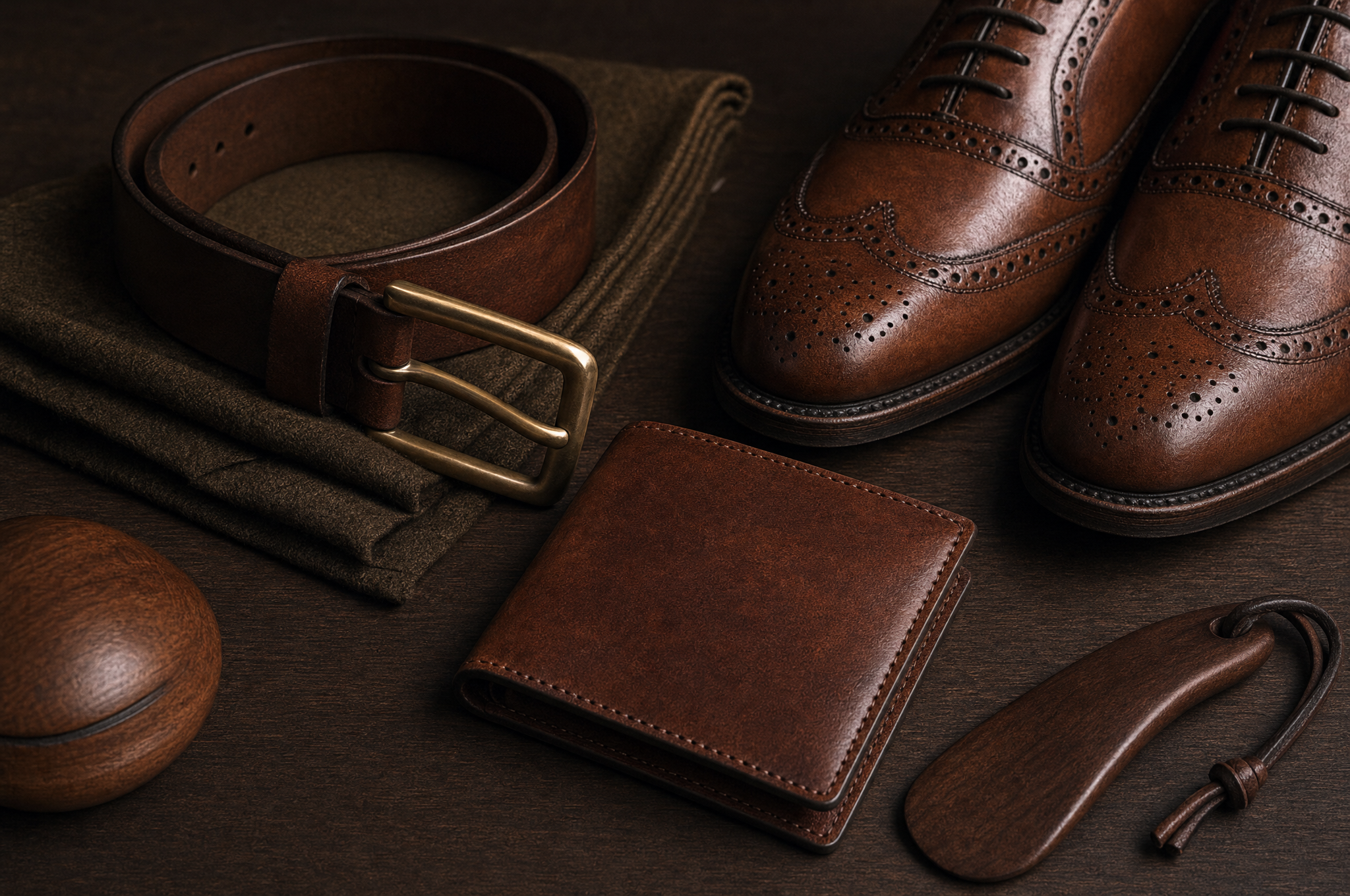
The highest grade. Full-grain uses the entire hide with the natural grain surface completely intact — no sanding, no buffing, no correction. It retains all the natural markings: scars, insect bites, stretch marks, vein lines. These aren't defects; they're the evidence that the leather is real and unprocessed. Over time, full-grain develops a patina — a rich, darkened sheen from oils, handling, and wear — that improves its appearance rather than degrading it.
Full-grain is the most durable leather because the grain's tight fibre structure is untouched. A full-grain belt or wallet can last decades. It's also the most expensive, because it requires a high-quality hide with minimal natural damage — you can't sand away the marks, so the hide has to be good enough to show.
Full-grain leather darkens and develops richness with wear. If a leather product looks the same after five years of use, it's not full-grain — it's been coated or treated to prevent change, which means it won't patina and won't last as long.
2. Top-grain leather
The second tier. Top-grain is the top layer of the hide, but it's been sanded or buffed to remove imperfections, then finished with a coating to even out the surface. The sanding removes the natural grain's tightest fibres, and the coating replaces the natural surface with a uniform, synthetic-looking finish.
Top-grain is thinner and more uniform than full-grain. It's easier to work with, more consistent in appearance, and resistant to stains (the coating acts as a barrier). But it's less durable — the sanding weakens the fibre structure, and the coating prevents patina. A top-grain product will look the same in ten years as it does today, which sounds like a virtue but actually means it's not aging — it's just wearing down.
Many "premium" brands use top-grain and market it as high quality. It's not bad leather, but it's a step down from full-grain, and it shouldn't be priced the same. If a brand doesn't specify "full-grain," assume top-grain or lower.
3. Genuine leather
Here's where the marketing gets misleading. "Genuine leather" sounds like a quality claim, but it's actually the lowest grade of real leather. It's made from the lower layers of the hide (the corium) after the top-grain has been split off. These layers are weaker, looser in fibre, and lack the grain's durability.
To make genuine leather look presentable, it's heavily processed: painted, embossed with an artificial grain pattern, and coated with a synthetic finish. The result is a product that looks like leather from a distance but is essentially a thin layer of low-grade hide covered in plastic. It doesn't patina. It doesn't breathe. And it degrades — the coating cracks and peels, revealing the inferior material underneath.
"Genuine leather" is not a mark of quality. It's a legal minimum — the thinnest claim a seller can make while still using the word "leather." When you see it, treat it as a warning, not a selling point.
If a product only says "genuine leather" with no grade specified, it's almost always this. Brands that use full-grain or top-grain say so explicitly, because it's a selling point. "Genuine" is what you say when you have nothing better to claim.
4. Bonded leather
The lowest of the low. Bonded leather isn't really leather — it's leather scraps and fibres ground up, mixed with polyurethane or latex, and bonded onto a backing. It's the particleboard of the leather world: technically containing leather, but structurally a synthetic composite.
Bonded leather peels, cracks, and disintegrates. It has no durability, no patina, and no structural integrity. It's used in cheap furniture and low-end accessories where the goal is to put "leather" on the label at minimum cost. Avoid it entirely.
| Grade | Grain Intact? | Durability | Patinas? | Typical Price |
|---|---|---|---|---|
| Full-grain | Yes, untouched | Decades | Yes, beautifully | Highest |
| Top-grain | Sanded, coated | Years | No (coated) | High |
| Genuine | Removed | Months–few years | No (paint flakes) | Low–medium |
| Bonded | None (scrap composite) | Months | No (disintegrates) | Lowest |
What Sellers Don't Tell You
The grades tell you about the hide's origin, but they don't tell the whole story. Here are the things sellers routinely omit — and the questions you should ask.
Tanning method
Leather is tanned to preserve it, and the method matters as much as the grade. Vegetable tanning uses tree bark extracts and produces firm, patina-friendly leather that ages beautifully. Chrome tanning uses chromium salts and produces softer, more water-resistant leather that doesn't patina as richly. Most "premium" leather is chrome-tanned because it's faster and cheaper. Vegetable-tanned full-grain is the gold standard — and a brand that uses it will say so.
Origin of the hide
Where the animal was raised affects the leather. Hides from temperate climates (where animals face fewer insects and less scratching) tend to be cleaner and higher-quality. Italian, French, and American hides are generally premium. Hides from tropical climates often have more scarring and require more correction. A brand that's proud of its hide origin will mention it.
Thickness
Leather thickness (measured in ounces or millimetres) affects durability and structure. A full-grain belt should be 8–10 ounces (3.2–4mm) thick. A wallet might be 3–5 ounces. Thin leather, even full-grain, won't last. Sellers often don't list thickness because thinner leather is cheaper — but it's a critical spec for anything that takes wear.
Construction
Even the best leather fails if the construction is poor. Look for: stitched edges (not glued), edge finishing that's painted or burnished (not raw), and hardware (buckles, zippers) that's solid brass or steel, not plated. A full-grain wallet with glued seams and cheap zippers will fail before the leather does. Construction quality should match leather quality — and a good brand will be transparent about both.
How to Assess Leather in Person
When you can touch the leather, the grade becomes apparent. Full-grain feels substantial and slightly irregular — you can feel the natural texture, and if you press it, it shows a subtle wrinkle, not a flat smoothness. It smells like leather, not chemicals. The edges, if unfinished, show the full thickness of the hide.
Top-grain feels smoother and more uniform — the coating creates a slightly plastic feel. The surface is consistent, with no natural variation. It smells less pronounced.
Genuine leather feels thin and often has a spongy quality — the backing is visible at the edges, and the surface coating feels like paint over leather rather than leather itself. It may smell of chemicals.
Bonded leather feels like vinyl. It's stiff, thin, and the backing frays at the edges. If it looks like leather-printed plastic, that's essentially what it is.
The Bottom Line
When buying leather goods — a belt, a wallet, shoes, a bag — look for "full-grain" explicitly stated. If the brand doesn't say it, assume they can't. Ask about tanning method (prefer vegetable-tanned), hide origin (prefer European or American), and thickness (demand appropriate weight for the product). Check construction: stitched, not glued; solid hardware; finished edges.
A full-grain, vegetable-tanned belt will cost more than a "genuine leather" one — but it will last twenty years and look better with every one of them. The genuine leather belt will be in a landfill in two. Cost-per-wear favors the better piece every time.
Leather is one of the few materials where quality is visible to those who know what to look for. Now you know. Use it.