
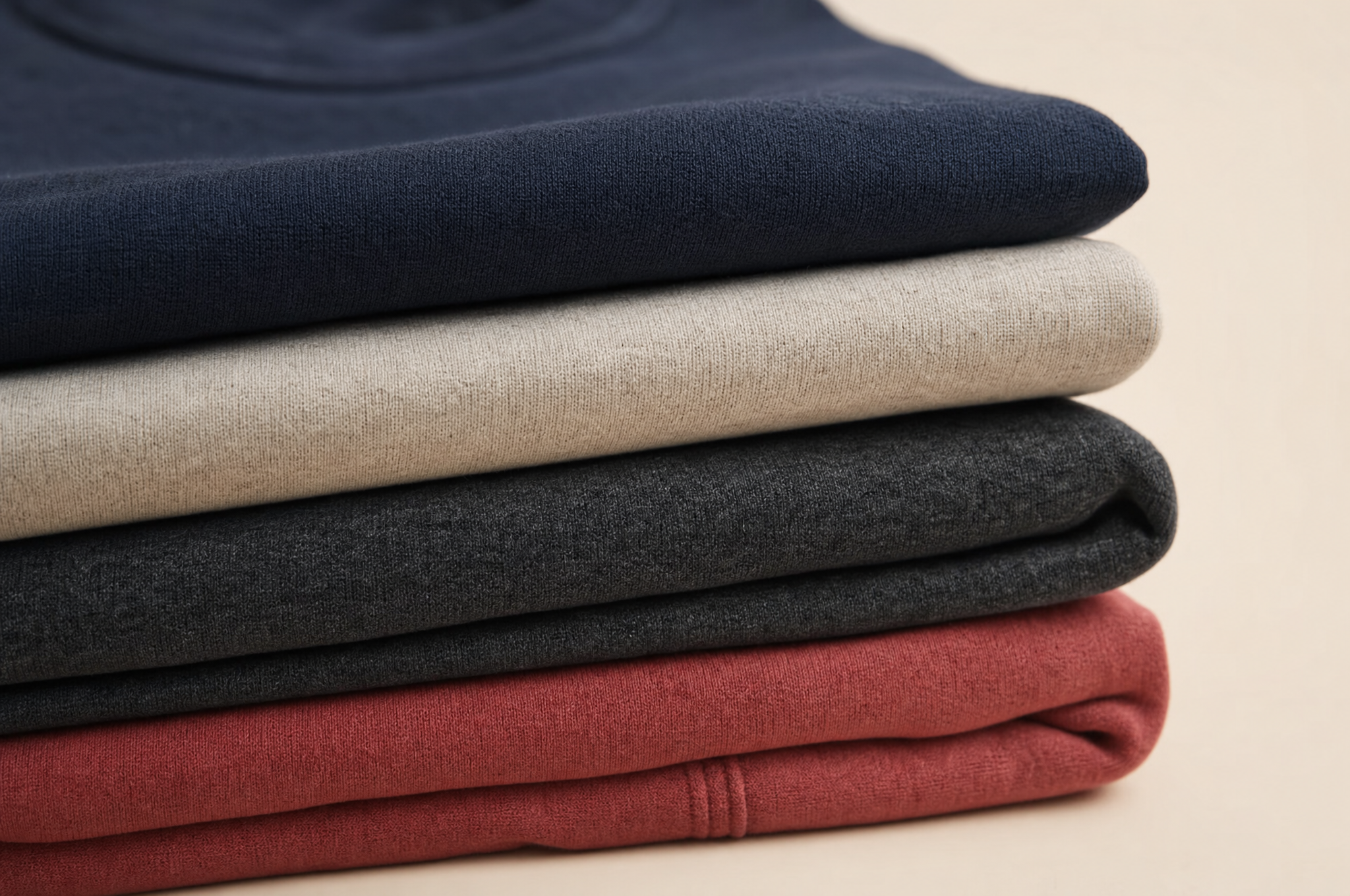
The t-shirt is the most democratic garment in menswear. Everyone owns them, everyone wears them, and the range in quality — from a £3 multipack singlet to a £60 Japanese loopwheel tee — is wider than in any other piece of clothing. The gap between the two extremes isn't just price. It's weight, construction, longevity, and how the fabric actually feels against your skin over a day of wear.
Here's the good news: you don't need the price tag to tell them apart. A quality t-shirt announces itself through four physical attributes that you can assess with your hands and your eyes in about thirty seconds. Learn these four checks, and you'll never overpay for a bad tee — or underestimate a good one — again.
Check 1: Fabric Weight
Weight is the single most reliable indicator of t-shirt quality. As we explain in our fabric weight guide, GSM (grams per square metre) measures how much material is in the fabric. For t-shirts, the ranges tell a clear story:
- 120–150 GSM: Lightweight. Summer tees, layering shirts. Thin, breathable, but translucent and short-lived.
- 150–180 GSM: Mid-weight. The standard for most commercial t-shirts. Adequate, but not substantial.
- 180–220 GSM: Heavyweight. The sweet spot for quality. Opaque, structured, holds its shape, and develops character with wear.
- 220+ GSM: Ultra-heavyweight. Built for durability and a structured, architectural look. Can feel stiff until broken in.
A cheap t-shirt is almost always under 160 GSM. Hold it up to the light — if you can see through it, it's too light to be durable. A quality tee at 200+ GSM will be fully opaque even under bright light, and the fabric will have a satisfying heft in your hand.
Pick up the t-shirt and let it drape over your hand. A lightweight tee will collapse immediately, almost weightless. A heavyweight tee will hold some structure, the fabric resisting gravity. That resistance is the substance you're paying for.
Check 2: Collar Construction
The collar is where a t-shirt fails first. A cheap collar stretches out after one wash, wrinkles at the edge, and turns a "sagging neckline" into the shirt's defining feature. A quality collar holds its shape through hundreds of wears and washes.
There are two things to look for. First, the collar should have a ribbed knit — a stretchy, textured band, not just a folded-over hem. The ribs give the collar elasticity so it recovers its shape after being stretched over your head. Second, look for collar tape: a strip of fabric sewn inside the neckline, running from one shoulder seam to the other. This tape stabilises the collar, prevents it from stretching over time, and covers the seam allowance for a cleaner interior.
The collar is the t-shirt's handshake. If it's limp, wrinkled, or loose, the rest of the shirt is built to the same standard.
Examine the collar edge. On a cheap tee, the edge will be a simple overlock stitch — a line of looping thread that's visible and prone to unravelling. On a quality tee, the collar will be double-stitched or cover-stitched, with two parallel lines of stitching that are flat, even, and secure. This is the difference between a collar that lasts ten washes and one that lasts two hundred.
Check 3: Seam Construction
Turn the t-shirt inside out. The seams tell you how much care went into construction, and how long the shirt will hold together.
On a cheap t-shirt, you'll see a single line of overlock stitching at every seam — the side seams, the sleeves, the hem. It's the fastest, cheapest way to join fabric. It works, but it's the first thing to fail: the thread frays, the seam loosens, and eventually the stitching gives way entirely.
On a quality t-shirt, the seams will be double-stitched (two parallel lines) or, on premium tees, flat-felled (the seam allowance is folded under itself and stitched down, creating a flat, smooth seam that's almost impossible to tear). Flat-felled seams are the gold standard — they're what you'll find on raw denim and workwear, and they transfer that same indestructibility to t-shirts.
Also check the side seams. Does the shirt have them? Some ultra-cheap tees are "tubular" — knit as a single tube with no side seam. This saves manufacturing cost, but it means the shirt has no structure: it twists, it bags out, and it never sits cleanly on the body. A quality tee will always have side seams, which give the shirt shape and allow the body to be tapered to fit.
Check 4: Fabric Composition and Knit
The fibre content matters, but not in the way most people think. "100% cotton" tells you almost nothing — the cotton could be short-staple (cheap, pills quickly) or long-staple (smooth, durable, resists pilling). The difference is enormous, and the label won't distinguish them.
What you can assess is the knit. Most t-shirts are jersey knit — a single knit with a smooth face and a looped back. Jersey is soft and stretchy, but it can be thin. A step up is a "loopwheel" knit, a slow traditional method (Japanese mills are famous for this) that produces a denser, more even fabric with no tension distortion. Loopwheel tees are expensive but they're the finest knit t-shirts money can buy.
Then check the stretch. A quality cotton t-shirt has natural give from the knit structure, but it shouldn't contain elastane or spandex unless it's an athletic tee. If the label lists "5% elastane," the shirt will lose its shape faster than a pure cotton one — the synthetic fibres break down with washing and leave the cotton sagging. Pure cotton, in a tight enough knit, holds its shape through years of wear.
The 30-Second Assessment
Here's the full check, condensed. Pick up the t-shirt. Hold it to the light — can you see through it? (If yes, too light.) Feel the weight in your hand — does it have heft, or does it float? Look at the collar — is it ribbed, taped, and cleanly stitched? Turn it inside out — are the seams double-stitched or flat-felled, and are there side seams? Read the label — is it pure cotton, or is it padded with elastane?
Four checks. Thirty seconds. And they'll tell you more about the t-shirt than the price tag ever could. A £15 heavyweight tee from a brand that publishes its GSM will outlast a £60 "designer" tee made from thin jersey with a single-stitched collar. The quality is in the construction, not the label.
Once you know what to look for, the gap between a good t-shirt and a bad one becomes impossible to miss. And once you've worn a properly made heavyweight tee — the kind that hangs with intent, holds its collar, and survives a hundred washes without losing its shape — going back to the cheap ones feels like wearing paper.