
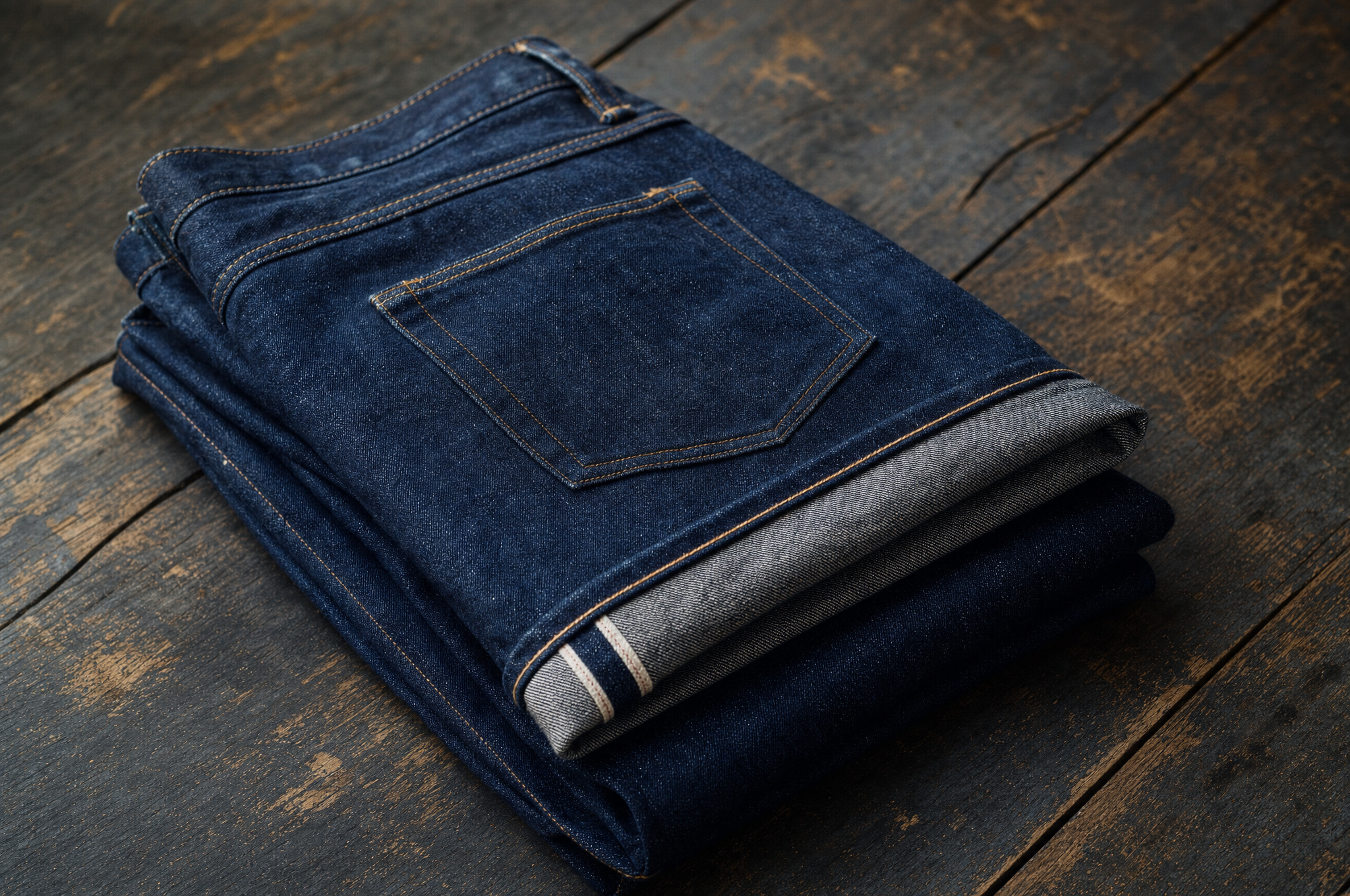
The first time you put on a pair of raw denim jeans, they will feel wrong. They'll be stiff — almost cardboard-like. They'll resist bending at the knee. The waist will feel tighter than the size suggests, and the indigo will be so dark it looks black. You will wonder, reasonably, whether you've made a mistake.
You haven't. Raw denim is a commitment garment — it starts uncomfortable and gets better with every wear, conforming to your body and fading in patterns that are uniquely yours. But the internet is full of mythology about raw denim: wash never, soak in the ocean, freeze your jeans to kill bacteria, wait six months before the first wash. Most of this is folklore dressed up as expertise. Here's what actually happens, month by month, based on how denim genuinely behaves.
What "Raw" Actually Means
Raw denim is denim that hasn't been washed or treated after dyeing and weaving. Most jeans you buy in a store have been washed, distressed, or treated to soften them and create a pre-faded look. Raw denim skips all of that — you get the fabric exactly as it came off the loom, starched and saturated with indigo. The breaking-in process is entirely yours.
There's a related term: selvedge. Selvedge denim is woven on old shuttle looms that produce a tightly woven, self-finished edge (the "selvedge") that doesn't unravel. It's visible when you cuff the jeans — a narrow woven band, often with a red or coloured thread. Selvedge is a marker of traditional construction, but it's not the same as raw. You can have washed selvedge or raw non-selvedge. The two concepts are independent, though they often appear together.
Raw = unwashed. Selvedge = woven on a shuttle loom with a finished edge. They're different things that the denim world has conflated into one myth.
One more distinction: sanforized vs unsanforized. Sanforized denim has been pre-shrunk — it'll shrink very little (1–3%) when washed. Unsanforized ("shrink-to-fit") denim will shrink 8–10% on the first soak. Know which you're buying, because it changes the sizing strategy entirely. Unsanforized requires a hot soak before wear; sanforized does not.
Month 1: The Stiff Phase
For the first two to four weeks, raw denim is genuinely uncomfortable. The fabric is stiff from the starch applied during weaving, the indigo is stiff from the dye, and the jeans haven't yet conformed to your body's creases. They'll feel restrictive at the waist, stiff at the knees, and the seams will feel prominent against your skin.
This is normal. The stiffness is temporary. Every time you bend, sit, or move, you're creating crease patterns at your natural flex points — the backs of the knees, the hips, the lap. These creases are where the indigo will eventually fade, creating the "whiskers" and "honeycombs" that raw denim enthusiasts prize. The jeans are learning your body.
Wear them. A lot. Aim for daily wear if possible — the more you move in them, the faster they break in. Don't wash them. Don't soak them (if sanforized). Just wear them through the discomfort. It passes.
One warning: the indigo will transfer. Raw denim "crocks" — the dye rubs off on light surfaces. Light-coloured shoes, white sneakers, and light upholstery will pick up blue marks, especially in the first few weeks. This fades as the surface dye wears, but be mindful of what you pair them with early on.
Months 2–3: The Softening
Around the six-week mark, the transformation begins. The starch breaks down from body heat and movement, the fabric softens, and the jeans start to feel like clothing rather than armour. The creases you've been forming become permanent — you'll see faint lines at the lap and knees where the indigo is beginning to lighten.
The waist will have stretched slightly (denim stretches up to an inch in the waist with wear), and the jeans will feel more comfortable than they did on day one. This is the reward phase — the discomfort is behind you, and the fading is beginning to show.
Still don't wash. The fading that's starting to appear is from mechanical friction — your body rubbing against the fabric — and washing would reset the contrast, distributing the indigo loss evenly and killing the character you're building. The goal of the first few months is maximum contrast between the high-wear areas (which lose indigo) and the low-wear areas (which stay dark).
Month 4–5: Visible Character
By month four, the fading is unmistakable. Whiskers at the hips, honeycombs behind the knees, and lighter patches at the wallet pocket and belt loops. The jeans look lived-in — not dirty, but worn in a way that's distinctly yours. No one else's pair will fade exactly like yours, because no one else has your body's exact movement patterns.
The fabric will have softened further and developed a slight sheen at the high-wear points from the cotton fibres being polished by friction. The jeans are now fully comfortable — they move with you, they've conformed to your body, and they feel broken in the way only raw denim can.
This is when most people get impatient and want to wash. Resist if you can. The longer you go before the first wash, the more dramatic the contrast will be. Six months is the conventional target, but it's not a rule — if the jeans are genuinely soiled (spills, odour, visible dirt), wash them. A pair of jeans that smells bad is not a badge of honour.
Month 6: The First Wash
When you do wash — whether it's at six months or sooner — do it properly. Turn the jeans inside out. Wash them alone or with dark colours (the first wash releases a lot of indigo). Use cold water and a mild detergent, ideally one designed for dark colours. If you're using a machine, use the gentlest cycle. If you're washing by hand, soak them in a tub of cold water with a small amount of detergent for 30–45 minutes, then rinse.
The first wash will cause some overall fading — the entire pair will lighten slightly — but it will also "set" the contrast you've built. The high-wear areas, which have already lost most of their indigo, won't change much. The low-wear areas will lose a bit of surface dye, making the contrast lines sharper and more defined. The result is the look most people associate with well-worn raw denim: dramatic whiskers and honeycombs against a still-dark base.
Never put raw denim in the dryer. Hang them or lay them flat to air-dry, preferably out of direct sunlight. Heat from a dryer will shrink them, damage the fibres, and cause uneven fading.
After the First Wash: Settling In
After the first wash, the jeans enter a new phase. The initial break-in is complete — the fabric is soft, the creases are set, and the fading pattern is established. From here, the jeans continue to evolve more slowly. Each subsequent wash will add subtle fading, and the high-wear areas will gradually lighten further. The contrast will soften over years, eventually giving way to a more uniform, faded-from-wear look.
You don't need to maintain the six-months-between-washes rule going forward. After the first wash, wash them when they need it — every 15–30 wears is reasonable for most people. The care principles are similar to knitwear: gentle cycle, cold water, air dry, and avoid over-washing.
Managing Expectations
The internet has created unrealistic expectations for raw denim. The dramatic, high-contrast fades you see in online forums are usually the result of specific conditions: heavy daily wear, no washing for extended periods, and often a heavier denim weight (14oz+) that creates sharper creases. If you wear your jeans a few times a week, wash them when they need it, and live a normal life, your fades will be subtler — and that's fine.
The point of raw denim isn't to achieve the most dramatic fade possible. It's to wear a garment that improves with age, that tells the story of your body and your habits, and that lasts years longer than pre-washed, pre-distressed denim. A pair of raw jeans, worn regularly and cared for properly, will outlast three or four pairs of conventional jeans. That's the real value — not the Instagram fade, but the longevity.
If you're building a capsule wardrobe, a pair of dark raw denim is the most versatile casual bottom you can own. It starts stiff, it ends beloved, and in between, it becomes uniquely yours.